The Commission is pleased to announce the publication of its Report on Compensating Victims of Crime.
The Press Release can be found here, as Gaelige anseo.
The Executive Summary can be found here.
You can view the full text here.

The Commission is pleased to announce the publication of its Report on Compensating Victims of Crime.
The Press Release can be found here, as Gaelige anseo.
The Executive Summary can be found here.
You can view the full text here.
Open competition for appointment to the position of:
Legal Researcher (3-year Contract)
in
The Law Reform Commission
Closing date: 12 noon on 23rd March 2026
The Law Reform Commission is a statutory body established by the Law Reform Commission Act 1975. The Commission has five members: the President, the Full-time Commissioner, and three part-time Commissioners.
Its role is to keep the law under independent, objective, and expert review, to make recommendations for law reform and to make current law accessible for all.
Under the supervision of the Director of Research and Deputy Directors of Research, the Legal Researcher will carry out research and assist in preparing Consultation Papers and / or a Report or Reports for publication. The Legal Researcher will be credited as a researcher on the project when a Consultation Paper or Report is published.
Current projects include:
Future projects include:
The work of the Commission and its Legal Researchers involves extensive consultation with relevant people and bodies, including members of the public, Members of the Oireachtas, Government Departments, the legal profession and other relevant professions, industry, State bodies and NGOs. Comparative research on the laws of other jurisdictions is an essential part of the research process. The Commission maintains extensive library resources for this purpose, including online resources such as VizLegal, LexisNexis and Westlaw.
Researchers may be required to attend meetings of the Commission to discuss their work, including draft papers, and to receive direction.
Researchers may also contribute to the work of Access to Legislation, see below. This work may be assigned for periods of up to 6 months on a revolving basis among the researchers. In addition, one researcher may be assigned to this work fulltime.
The Researcher will, under the supervision of the Access to Legislation Manager and Deputy Managers, contribute to the Commission’s important work on Access to Legislation which produces the Legislation Directory, Revised Acts and the Classified List of In-Force Legislation. In relation to the Legislation Directory, this will involve detailed reading of legislation and noting of effects and other elements such as commencement information. The work on Revised Acts will entail the analysis of amendments and other legislative effects and their incorporation using an XML authoring system. Work on the Classified List will involve the use of an IT system to update and maintain the List.
Under the supervision of the Access to Legislation Manager and the Director of Research successful candidates will:
Applicants should note that the above is a general guide to the role in these areas and is not an exhaustive description of the duties which are associated with the role or tasks which may be assigned to the role of Legal Researcher in the Law Reform Commission. Applicants should also note that additional duties may be assigned from time-to-time.
Candidates must, on or before 28th February 2026
a) hold at least a 2:1 honours law degree (at least a Level 8 on the National Framework of Qualifications) or a recognised relevant professional legal qualification;
and
b) Have demonstrable experience in conducting in-depth legal research and analysis gained either through relevant undergraduate or post-graduate studies or through conducting legal research and analysis in a practical professional context.
In addition, candidates must possess and be able to demonstrate:
The attention of candidates is drawn to the key competencies that are applicable to this post:
Please find the Information Booklet for this position here.
Please find the Application form for this position here.
Comórtas Oscailte le haghaidh ceapadh chuig an bpost seo:
Taighdeoir Dlí (Conradh Sealdach Lánaimseartha Trí Blina)
sa
Choimisiún um Athchóiriú an Dlí
Dáta dúnta: 12 meán lae ar an 23 Márta 2026
Comhlacht reachtúil a bunaíodh leis an Acht fán gCoimisiún um Athchóiriú an Dlí, 1975, is ea an Coimisiún um Athchóiriú an Dlí. Tá cúigear comhaltaí ag an gCoimisiún: an tUachtarán, an Coimisinéir Lánaimseartha, agus triúr Coimisinéirí páirtaimseartha.
Is é an ról atá aige an dlí a choinneáil faoi athbhreithniú neamhspleách, oibiachtúil agus saineolach, moltaí a dhéanamh le haghaidh athchóiriú an dlí, agus an dlí reatha a dhéanamh inrochtana do gach duine.
Ag obair dó/di faoi mhaoirseacht an Stiúrthóra Taighde agus na Leas-Stiúrthóirí Taighde, déanfaidh an Taighdeoir Dlí taighde agus cabhróidh sé/sí le Páipéir Chomhairliúcháin agus/nó Tuarascálacha a ullmhú lena bhfoilsiú. Aithneofar an Taighdeoir Dlí mar thaighdeoir ar an tionscadal nuair a fhoilseofar Páipéar Comhairliúcháin nó Tuarascáil.
Áirítear leis na tionscadail reatha:
Áirítear leis na tionscadail amach anseo:
Is é atá i gceist le hobair an Choimisiúin agus a Thaighdeoirí Dlí ná comhairliúchán fairsing le daoine agus comhlachtaí ábhartha, lena n-áirítear daoine den phobal, Comhaltaí den Oireachtas, Ranna Rialtais, an lucht dlí agus gairmithe ábhartha eile, an lucht tionscail, comhlachtaí Stáit agus eagraíochtaí neamhrialtasacha. Cuid bhunriachtanach den phróiseas taighde is ea taighde comparáideach ar dhlíthe dlínsí eile. Coimeádann an Coimisiún acmhainní fairsinge leabharlainne chun na críche sin, lena n-áirítear acmhainní ar líne amhail VizLegal, LexisNexis agus Westlaw.
Is féidir go gceanglófar ar thaighdeoirí freastal ar chruinnithe de chuid an Choimisiúin chun plé a dhéanamh ar a gcuid oibre, lena n-áirítear dréachtpháipéir, agus chun treoir a fháil.
Is féidir go rannchuideoidh taighdeoirí freisin leis an obair atá ar bun ar Rochtain ar Reachtaíocht, féach thíos. Is féidir go sannfar an obair sin do thaighdeoirí ar bhonn rothlach lena cur i gcrích thar thréimhsí a mhaireann suas le sé mhí. Is féidir go sannfar taighdeoir amháin don obair sin ar bhonn lánaimseartha freisin.
Ag obair dó/di faoi mhaoirseacht an Bhainisteora um Rochtain ar Reachtaíocht agus na Leas-Bhainisteoirí um Rochtain ar Reachtaíocht, rannchuideoidh an Taighdeoir le hobair thábhachtach an Choimisiúin ar Rochtain ar Reachtaíocht, rud a tháirgeann an tEolaire Reachtaíochta, Achtanna Athbhreithnithe agus an Liosta Aicmithe den Reachtaíocht atá i bhFeidhm. Maidir leis an Eolaire Reachtaíochta, is é a bheidh i gceist leis sin ná reachtaíocht a léamh go mion agus trácht ar éifeachtaí agus ar ghnéithe eile amhail faisnéis tosach feidhme. Is é a bheidh i gceist leis an obair ar Achtanna Athbhreithnithe ná anailís a dhéanamh ar leasuithe agus ar éifeachtaí reachtacha eile agus iad sin a chur ar áireamh trí chóras ceapadóireachta XML a úsáid. Is é a bheidh i gceist leis an obair ar an Liosta Aicmithe ná úsáid a bhaint as córas TF chun an Liosta a athrú chun dáta agus a choimeád.
Ag obair dóibh faoi mhaoirseacht an Bhainisteora um Rochtain ar Reachtaíocht agus an Stiúrthóra Taighde, déanfaidh iarrthóirí rathúla na nithe seo a leanas:
Ba cheart d’iarratasóirí a thabhairt faoi deara go bhfuil an méid thuas ina threoir ghinearálta ar an ról sna réimsí sin agus nach bhfuil sé ina thuairisc uileghabhálach ar na dualgais a bhaineann leis an ról nó leis na cúraimí a shannfar do ról an Taighdeora Dlí sa Choimisiún um Athchóiriú an Dlí. Ba cheart d’iarratasóirí a thabhairt faoi deara freisin gur féidir go sannfar dualgais bhreise ó am go chéile.
Ní mór d’iarrthóirí na nithe seo a bheith acu an 28 Feabhra 2026 nó roimh an dáta sin:
a) céim onóracha 2:1 sa dlí (ag Leibhéal 8 ar a laghad ar an gCreat Náisiúnta Cáilíochtaí) nó cáilíocht aitheanta ghairmiúil ábhartha sa dlí ar a laghad;
agus
b) taithí inléirithe ar thaighde domhain dlí agus anailís dhomhain dlí a dhéanamh, ar taithí í a gnóthaíodh trí staidéar ábhartha fochéime nó iarchéime a dhéanamh nó trí thaighde domhain dlí agus anailís dhomhain dlí a dhéanamh i gcomhthéacs praiticiúil gairmiúil.
Ina theannta sin, ní mór d’iarrthóirí na nithe seo a leanas a bheith acu agus a bheith in ann iad a léiriú:
Faigh an Leabhrán Faisnéise don phost seo anseo.
Faigh an Fhoirm Iarratais don phost seo anseo.
The Law Reform Commission held an introductory discussion to its recently published Consultation Paper on the Reform of Non-Court Adjudicative Bodies and Appeals to Courts.
President Frank Clarke, Commissioner Richard Barett and Professor Paul Daly discussed the proposals for reform at a presentation on the 10th February, 2026. The discussion was chaired by Judge Marguerite Bolger. The purpose of the discussion was to explain the scope and purpose of the project, to stimulate debate and facilitate interested parties in preparing submissions on all aspects of the proposed reforms. A Recording of this event may be found below.
Watch the Non-Court Adjudicative Bodies Introductory Discussion.
Please note that the deadline for submissions has been extended to 22 July 2026.
Submissions are invited from all interested parties on the Commission’s Consultation Paper entitled Non-court Adjudicative Bodies.
The full text of the Consultation Paper can be found here.
The relevant executive summary can be found in here.
Tá an athchoimre feidhmeannach ar fáil anseo.
Details of the various options to submit your response – whether by email (direct to: ncabs@lawreform.ie) or by post – can be found here.
Contributors are requested to make their submissions/comments, if possible, before close of business on 23rd June, 2026.
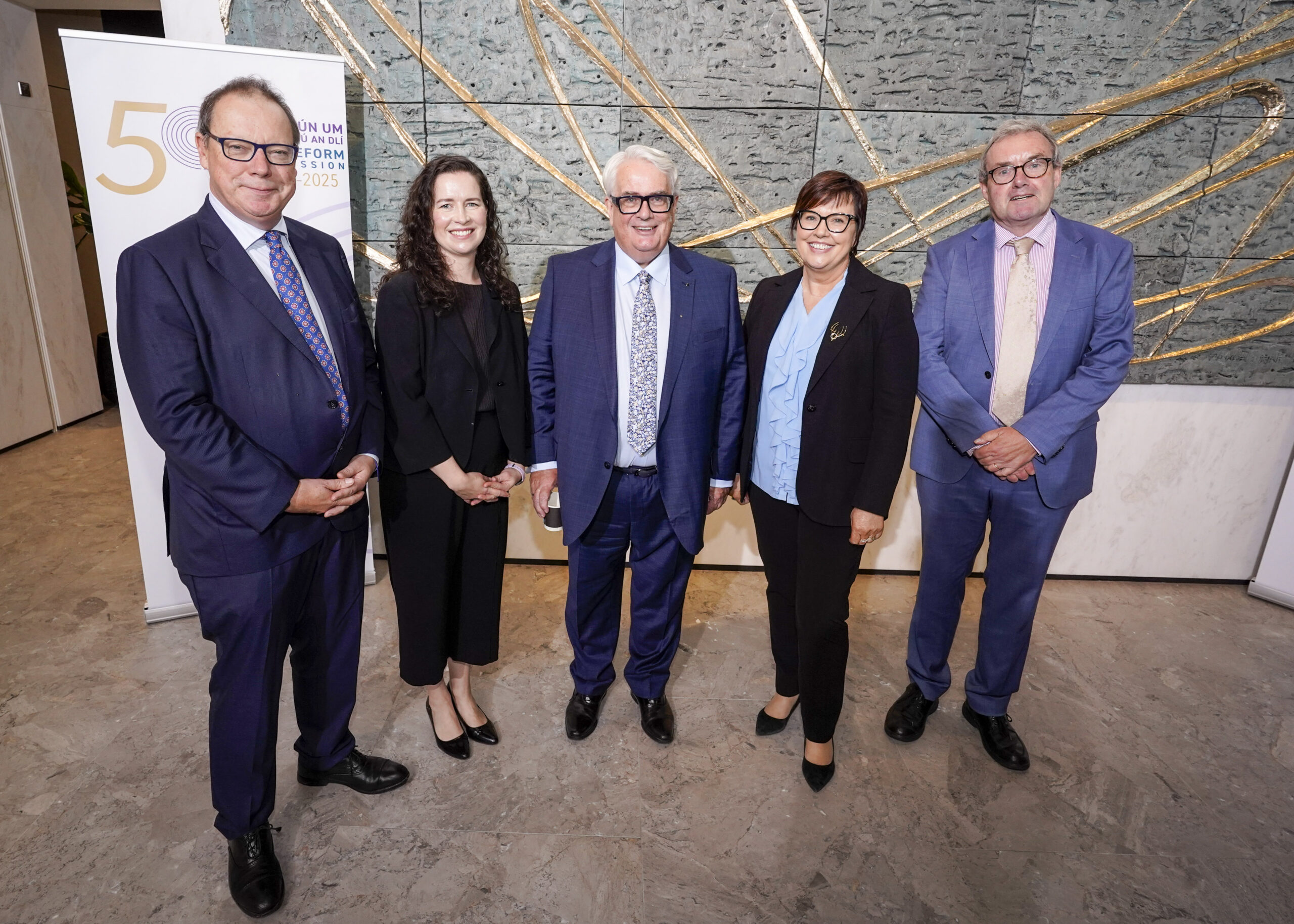
From Left: Commissioner Maurice Collins, Commissioner Dr Andrea Mulligan, President Frank Clarke, Commissioner Eileen Roberts and Commissioner Richard Barrett pictured at the Law Reform Commission’s recent conference to celebrate the 50th anniversary of its establishment – ‘Half a Century of Change: The Journey of Law Reform’.
The conference was a celebration of the work of the Law Reform Commission and its contribution to accessible and modern law-making in Ireland. Attended by present and former Commissioners and researchers, the event was convivial and friendly. There was a real sense of pride in our collective achievement. Congratulations and well done to all involved.
Click here to read the papers presented at the conference and other related speeches.
Trinity Long Room Hub
18 September 2025
Programme
To mark its 50th Anniversary, the Law Reform Commission of Ireland is partnering with the Trinity Centre for Constitutional Governance (TriCON) to host an academic conference on the history and future of law reform. The conference will take place in Trinity College Dublin on the afternoon of Thursday 18 September, the day before a related conference in Dublin Castle organised by the Law Reform Commission itself, Half a Century of Change: The Journey of Law Reform.
In a politically polarised world, the challenge of law reform is greater than ever. How can appropriate subjects for law reform be identified? What form of democratic processes are required to legitimise law reform? What roles do and should stakeholders and lobby groups play in the process of law reform? How can political support be built for urgently needed law reform? The papers selected for this conference address these and other questions.
| 12.30-1.30 | Registration and light lunch |
|---|---|
| 1.30-1.45pm | Welcome and opening remarks |
| 1.45-3.05pm | Session 1
Legal Change outside Law Reform Institutions |
| Nevi Agapiou, Functional Law Reform: The Distinctive Case of Cyprus | |
| Alan Eustace and Michael Doherty, The Many About-Faces of Labour Law Reform in Ireland | |
| James Rooney, Multi-Party Litigation and the Limits of Law Reform in Ireland | |
| Jennifer Schweppe, Amanda Haynes and Luke Danagher, The Criminal Justice (Hate Offences) Act 2024: A Scottish Act ‘emblazoned with the harp’? | |
| 3.05-3.25pm | Coffee |
| 3.25-4.45pm | Session 2
Law Reform Institutions |
| Adam Elebert, The Role and Value of Law Reform Institutions in Constitutional Referendums | |
| Stephen Marren, From Disarray to Order: The Role of Codification and Law Reform Bodies | |
| David Plater and Emily Conroy, A Win-Win Situation? A South Australian Perspective on the Mutual Benefits of Collaboration between Law Students and Law Reform Bodies | |
| Mark Coen, The False Promise of ‘Law Reform’: The Law on Juries as a Case Study | |
| 4.45-5.05pm | Coffee |
| 5.05-6.25pm | Session 3
Law Reform: Past, Present, and Future |
| Alice Diver, Law reform [as redress] for Survivors/Victims of Mother-Baby Institutions in Northern Ireland: Public Consultation as a perpetuation of unseen partialities? | |
| Niamh Howlin, Law Reform before the Law Reform Commission | |
| Michael McGrath, The Introduction of Land Registration | |
| Suzanne Scott, The Power of Stories to Influence Law Reform | |
| 6.26-6.35pm | Closing remarks |
More information on this event is available here.

An tseachtain seo bhí an-áthas orainn fáilte a chur roimh bhuaiteoirí cumasacha ár gcomórtas aistí don Idirbhliain (IB)! Bhuail na buaiteoirí leis an Uachtarán a bhronn a dteastais tuillte go maith orthu.
Eagraithe mar chuid dár gceiliúradh 50 bliain, thug an comórtas seo dúshlán do mhic léinn na hIdirbhliana a gcuid smaointeoireachta a chur orthu féin agus dlí a mholadh a chreideann siad a bhfuil athchóiriú tuillte aige amach anseo. Ba é an aidhm a bhí againn spéis a spreagadh in obair ríthábhachtach athchóirithe an dlí agus an chéad ghlúin eile taighdeoirí dlí a chothú.
Ba mhaith linn buíochas a ghabháil le gach dalta a ghlac páirt sa chomórtas agus leis na múinteoirí a spreag iad chun páirt a ghlacadh.
Ba iad na buaiteoirí:
Trí Aiste is Fearr don Idirbhliain (i mBéarla)
Trí Aiste is Fearr don Idirbhliain (i nGaeilge):
Bhí an doimhneacht taighde, smaointeoireachta criticiúla, agus feasachta sochaí a léiríodh sna hiontrálacha uile thar a bheith suntasach. Léiríonn na daoine óga seo todhchaí gheal don dioscúrsa dlí agus don dul chun cinn sóisialta in Éirinn. Comhghairdeas arís lenár mbuaiteoirí, agus buíochas le gach duine a chuir le rath an chomórtais spreagúil seo!
This week we had the pleasure of welcoming the talented winners of our Transition Year (TY) essay competition! The prize winners met with the President who presented them with their well-deserved certificates.
Organised as part of our 50th anniversary celebrations, this competition challenged TY students to put on their thinking caps and propose a law they believe deserves reform in the future. Our aim was to ignite an interest in the crucial work of law reform and cultivate the next generation of legal researchers.
We would like to thank every student who took part in the competition and the teachers who encouraged their participation.
The winners were:
Top Three TY Essays (in English):
Top Three TY Essays (in Irish):
The depth of research, critical thinking, and societal awareness demonstrated in all the entries was truly remarkable. These young individuals represent a bright future for legal discourse and social progress in Ireland. Congratulations once again to our winners, and thank you to everyone who contributed to the success of this inspiring competition!
On March 19th, members and staff of the Law Reform Commission visited the University of Limerick to co-host a seminar on the ongoing Compensating Victims of Crime project. The event, organised in collaboration with the UL School of Law, provided an opportunity to engage with students, academics, and legal professionals on issues related to victims’ rights and compensation. The Commission’s team was warmly welcomed by the School, which facilitated a three-speaker conference on “A Rights-Based Approach to Victims’ Compensation.”

The Law Reform Commission recently participated on the Fifth Court podcast to commemorate 50 years since its establishment, to discuss its current work and the plans to celebrate its 50 year anniversary throughout 2025. The Fifth Court podcast is hosted by Mark Tottenham BL and Peter Leonard BL who discuss legal news and case insights, in addition to welcoming guests from the legal sector.
The LRC’s Director of Research, Siobhán Ní Chúlacháin, explained the Commission’s purpose and why there was a need for an independent body to review the law in 1975 and why that need still exists. She also talked about the early years of the Commission and its many achievements throughout the years. Siobhán spoke about the role of the Commission with regard to accessibility to legislation. In particular, she talked about the compilation of Revised Acts and the work being carried out as part of the Statute Law Revision Programme.
Legal researcher Caoilin Young discussed the Commission’s research process and the stages of a law reform project, in context of the projects currently on the Commission’s agenda – Reform of Non-Court Adjudicative Bodies and Appeals to Court, which is at consultation stage, and Compensating Victims of Crime and Third Party Litigation Funding, which are both at report stage. She also discussed the implementation rate of the Commission’s work, with reference to the recent report on the Regulatory Framework for Adult Safeguarding, and the various ways in which recommendations from the Commission’s reports may become law.
They also highlighted the Commission’s Annual Conference which will take place on September 19th, Half a Century of Change: The Journey of Law Reform. This conference will bring together law reform bodies from other jurisdictions, as well as academics and practitioners, to have a fruitful discussion on the past, present and future of law reform in Ireland.
As is tradition on the Fifth Court Podcast, Siobhán and Caoilin were asked to give a cultural recommendation with a legal theme – Siobhán recommended the movie The Motorcycle Diaries and Caoilin recommended the book, Unlawful Killings by Wendy Joseph, KC.
To listen to this podcast in full, please click here.
Event: Launch of the Law Reform Commission Report on ‘A Regulatory Framework for Adult Safeguarding’
Speaker: The Attorney General, Rossa Fanning S.C.
President of the Law Reform Commission, distinguished guests, friends and colleagues, may I begin by saying it is a real pleasure to be here this morning to formally launch the Law Reform Commission’s Report on ‘A Regulatory Framework for Adult Safeguarding’.
The list of novelties for an Attorney General does start to reduce as time goes on, though I have had some new experiences in recent months, from appearing as an advocate in the ICJ in February, to going to a Council of State meeting and acting in the first Article 26 reference for 18 years, to being re-nominated by a new Taoiseach last week and to delivering a tribute only on Monday to a retiring Supreme Court Judge, Ms Justice Baker, who of course served as a part-time Law Reform Commissioner between 2012 and 2015.
But, this is the first occasion I have had the pleasure of attending at the launch of a Law Reform Commission Report, and I am delighted to tick that particular box today off my Merrion Street bucket list today.
In that context, and with the 50th anniversary of the establishment of the Commission falling next year, I thought it appropriate to briefly say something at the outset about the origins of the Commission, and in particular, its links with my Office.
In making such remarks, I am counting on not being subject to any hard questioning here this morning, such as that which my predecessor, Declan Costello SC, was obliged to weather when navigating the Law Reform Commission Act, 1975 through the Houses of the Oireachtas, from the likes of Major Vivion De Valera and Gerry Collins. In fact, so eager were parliamentarians to question my predecessor in relation to this legislation that the Seanad even amended its Standing Orders to enable the Attorney General, who was of course also a TD, to participate in the debates in the Upper House.1
However, it is, I think, worth recalling some of the comments he made in the course of those debates, and reflecting on the accuracy of many of the predictions that he made about the Commission.
Declan Costello was among the very first to recognise that law reform is one of the most important tools available to Government to meaningfully reform the society for which it is responsible.2
Such an approach to law reform was, he stressed, for the benefit of all, rather than “a concept of interest only, or indeed primarily for, lawyers”. 3
Rather, law reform provided an opportunity for injustices or inconsistencies in the law to be identified and rectified.
It also provided a clear opportunity to the legislature to intervene and re- adjust or re-balance an approach to a certain issue being taken by the Courts.
In a dynamic and fast-changing world, he said it was incumbent upon us to ensure the law is kept under constant review and regularly reformed.4
Even in those days, let alone now, the regulatory footprint of the State was expanding, and in that context, it would be hard to disagree with his conclusion that “virtually every important and significant private, economic and social relationship” is affected by the law. 5
He was anxious not only that the importance of law reform be recognised, but that this would be achieved in the right way.
In September 1974, James Downey writing in The Irish Times, reported from the Government press briefing announcing the legislation, noting Declan Costello as saying that:
“We are, I am afraid, very backward in this country in law reform, partly because we have not had the structures which we are now setting up”6
He emphasised that that the creation of a dedicated law reform body was required to give the attention and priority to law reform which was sometimes lacking and “too slow in the past”.7
It is I think, fair to say that this vision has been vindicated in the decades since, with the Commission taking a central place in legal discussions, both in Courts8 and in the drafting of new legislation.
The Commission itself has identified that approximately 70% of the various reports and papers it has issued in the years to January 2020 have had an influence on subsequent legislative reform.9
These reform efforts have come in areas of acute interest to the general public, with important and influential reports published in recent years in areas such as conveyancing, harassment and digital safety and consumer insurance contracts.10
However, even aside from its parent legislation being personally shepherded through the legislative process by the Attorney General, the Law Reform Commission continues to have a particularly close relationship with my Office.
Whilst entirely independent in its day-to-day operations, its statutory structure means the Commission is funded from the funds of the Office of the Attorney General, as voted by the Dáil on an annual basis.
The Commission also collaborates with my Office in maintaining a Legislation Directory for the Irish Statute Book website. This Directory tracks the commencements, changes of construction and amendments to legislation passed throughout not only the State’s history, but dating back centuries in certain rare cases.
And as it happens, the position of full-time Commissioner is presently held by one Richard Barrett, a former Deputy Director-General in the Office of the Attorney General.
Under the 1975 Act, I also have a statutory role in relation to the work of the Commission who must consult with me in relation to its Programmes of Law Reform.
Ironically, we were due to have a meeting last Tuesday afternoon, but it had to be postponed as, by virtue of the subtlety of Article 30 of the Constitution, I ceased to be Attorney General at 2.15pm last Tuesday on the appointment of a new Taoiseach, albeit that I regained the status about seven hours later in Áras an Uachtaráin.
I am a statutory consultee because, as Declan Costello stated:
“the Attorney General is especially qualified to discuss with the commission the needs of all Government Departments in matters relating to law reform”. 11
Positioned at the juncture of the legal and political arms of the State, my predecessor observed that the Attorney General of the day “is uniquely situated”12 to assess legal developments in the aggregate, and with a whole-of-Government perspective.
The Attorney General can also have a more direct influence, if he or she specifically requests the Commission to examine specific areas of law outside of the set Programmes of Law Reform, as provided for in section 4(2)(c) of the 1975 Act.13
To date, 43 reports have been published pursuant to a request by the Attorney General, from the first request in 1975 on the appropriate ages of majority and for marriage, to the last in 2017 on the mental element of consent,14 with none outstanding.
So President, we will re-arrange that meeting postponed from last week in early course.
I now turn to the subject of the Commission’s Report here today, the enormous industry underlying which I place on the record my commendation and appreciation of.
The area of adult safeguarding has been the subject of increased attention in recent years, in particular with the reforms implemented in line with the Domestic Violence Act 2018 and the commencement of the Assisted Decision Making Act 2015 in April 2023.
This Act was of course largely implementing recommendations made by the Commission its 2006 Report on ‘Vulnerable Adults and the Law’.15
However, notwithstanding this earlier work, the issue of adult safeguarding was also included in the Commission’s Fifth Programme of Law Reform, in response to a Private Members Adult Safeguarding Bill in 2017.16
Indeed, it was during the course of the Seanad debates on this Bill, that the then Minister for Health, who since Tuesday last occupies an office close to my own in Merrion Street, recognised:
“that there was a need for an appropriate statutory framework for the safeguarding of vulnerable or at-risk adults”.17
The publication of the Commission’s Report today, which expresses a preference for the term “at-risk adults” is therefore, an important and timely intervention.
At the heart of today’s recommendations is the Commission’s conclusion that there is a clear need for a statutory regulatory framework for adult safeguarding in Ireland.
Through its Report, the Commission traces the development of Ireland’s approach in this area, and highlights the “existing gaps and shortcomings” in the current position, based on a combination of guidelines, policies and administrative schemes rather than legislation.
To rectify these shortcomings, the Commission recommends a comprehensive and cross-sectoral legislative scheme, which clearly allocates responsibility and oversight to different groups interacting with at-risk adults in all manner of different settings across Ireland.
Whilst not a panacea, such legislation would, the Commission concludes, focus minds, facilitate cooperation and ultimately, foster an improved society for everyone.
Today’s Report also includes recommendations for the definition of key terms in statute, to provide functional and legal clarity to terms which are familiar to many of us, such as “safeguarding”, “harm” and “capacity”.
It is also suggested that such definitions would be accompanied by a set of guiding principles, to provide a backdrop against which powers and functions would be exercised in this area.
These principles, which include a commitment to a rights-based approach, proportionality and accountability, ensure that individual cases, which are often difficult for all involved, are considered in the appropriate context.
Whilst any regulatory framework for at-risk adults would inevitably impact settings across society, the Commission has also recommended that responsibility for leading and coordinating adult safeguarding practices would repose in a statutory “Safeguarding Body”.
This astute recommendation recognises the implicit truth that whilst there is great value to cooperation and collaboration, the diffusion of responsibility can, if taken too far, obscure accountability.
After all, if everyone is partially responsible, no one person or body is individually accountable.
The group, which today’s Report considers could be established either within the HSE or as an independent entity, would be social-work led and subject to meaningful scrutiny and oversight.
The Commission’s Recommendations strongly emphasise the duties of care owed by society to at-risk adults, including the duty to prevent harm to vulnerable adults.
However, in fulfilling these duties, the Commission emphasises that thinking has advanced significantly from the paternalistic notion that we must simply solve these people’s problems.
On the contrary, the Commission is clear that any legislation must aim to empower and assist, rather than control or direct.
This builds on the approach taken under the Assisted Decision Making Act 2015 and is reflective of international best practice, whereby the most vulnerable people in our society are heard as well as seen.
Throughout the Report, the Commission makes various civil and criminal law recommendations with the primary objective of putting measures in place to safeguard at-risk adults in this jurisdiction.
The Commission’s recommendations are reflected in two very useful draft pieces of legislation that accompany the Report: the Adult Safeguarding Bill 2024 and the Criminal Law (Adult Safeguarding) Bill 2024.
In closing, can I reiterate that the publication of this Report and its recommendations today is an impressive achievement, and one of both practical utility and admirable legal scholarship.
I would suggest that today’s Report is a fine model of the contemplative and considered approach to law reform which Declan Costello envisioned in the 1970’s at the time of the establishment of the Commission.
I want to publicly extend my appreciation to the Commissioners in situ for the lion’s share of the duration of this lengthy project – Mr. Justice Clarke, the President, Richard Barrett the full-time Commissioner, and Mr. Justice Maurice Collins, Ms. Justice Niamh Hyland and Dr. Andrea Mulligan, whilst also thanking Ms. Justice Hyland for her recently-concluded service to the Commission and welcoming Ms. Justice Eileen Roberts as her recently-appointed replacement.
I note from the Report that Andrea Mulligan was the Coordinating Commissioner, and that the Research manager was Leanne Caulfield and I draw special attention to their prominent role in this work, in addition to that of the cohort of principal legal researchers that are identified as having worked on the project – Colin Grant, Clodagh Hunt-Sheridan, Síona Molony, Ciara O’Brien and Katey Tolan.
I might also take this opportunity to congratulate my friend and long-time colleague at the Bar, Siobhán Ní Chúlacháin, on her recent appointment as Director of Research and I wish her well with her career with the Commission.
I have no doubt that the Report, its contents and recommendations will be given the careful consideration by Government that it deserves, which is of course the ultimate goal of the Commission’s work.
Thank you very much for listening to me, and I have no doubt that an interesting morning’s discussion awaits.
1 Seanad Deb 10 April 1975, vol 80, no 2.
2 Dáil Deb 4 February 1975, vol 277, no 10.
3 Seanad Deb 10 April 1975, vol 80, no 2.
4 Dáil Deb 4 February 1975, vol 277, no 10.
5 Dáil Deb 4 February 1975, vol 277, no 10; see also Seanad Deb 10 April 1975, vol 80, no 2.
6 James Downey, ‘Government to set up law reform body’ (The Irish Times, 17 September 1974).
7 Dáil Deb 4 February 1975, vol 277, no 10.
8 See, for example, DPP v Fergal Cagney [2008] 2 IR 111, O’Shea and O’Shea v Attorney General [2007] 2 IR 313 and DPP v McNamara [2021] 1 IR 472.
9 ‘What We Do: Measuring the impact of our work’ (Law Reform Commission): https://www.lawreform.ie/law-reform/overview.445.html.
10 Law Reform Commission, ‘Report on Reform and Modernisation of Land Law And Conveyancing Law’ (LRC 74 – 2005); Land and Conveyancing Law Reform Act 2009; Law Reform Commission, ‘Report on Harmful Communications and Digital Safety’ (LRC 116 – 2016); Harassment, Harmful Communications and Related Offences Act 2020; Law Reform Commission, ‘Report on Consumer Insurance Contracts’ (LRC 113 – 2015); Consumer Insurance Contracts Act 2019.
11 Seanad Deb 10 April 1975, vol 80, no 2.
12 Dáil Deb 4 February 1975, vol 277, no 10.
13 Law Reform Commission Act, s 4(2)(c).
14 Law Reform Commission, Report on the age of Majority, the Age for Marriage and Some Connected Subjects (LRC 5-1983); Law Reform Commission, Report on Knowledge or Belief Concerning Consent in Rape Law (LRC 122-2019); See further ‘Attorney General References’ (Law Reform Commission): https://www.lawreform.ie/law-reform/attorney-general-references.246.html
15 Law Reform Commission, ‘Report on Vulnerable Adults and the Law’ (LRC 83 – 2006).
16 Law Reform Commission, ‘Report: Fifth Programme of Law Reform (LRC 120 – 2019), para 1.05.
17 Law Reform Commission, ‘Report: Fifth Programme of Law Reform (LRC 120 – 2019), para 1.05.
-ENDS-
|
A Regulatory Framework for Adult Safeguarding:
|
Report:
|
Report:
|
Report:
|
Report:
|
|---|---|---|---|---|
| Easy-to-Read & Plain English Reports | Easy-to-Read Report | Plain English Report | ||
|
Summaries:
|
Achoimre Fheidhmeach
|
Easy-to-Read Summary | Plain English Summary | Summary of Recommendations |
| Glossaries: | Report Glossary | Plain English Glossary | ||
|
Draft Bills:
|
Adult Safeguarding Bill 2024 | Criminal Law (Adult Safeguarding) Bill 2024 |
How to cite our Report: A Regulatory Framework for Adult Safeguarding
Suggested citation format:
Law Reform Commission, A Regulatory Framework for Adult Safeguarding vol [insert volume number of the Report] (LRC 128 – 2024) at [insert page or paragraph number of the Report].
The 1,000 page Report: A Regulatory Framework for Adult Safeguarding details the proposed framework for adult safeguarding. It draws from extensive research and analysis of existing domestic law and policy and a comprehensive review of adult safeguarding legislative frameworks in other jurisdictions. The Law Reform Commission (“Commission”) engaged with regulators, professional bodies, relevant government departments, human rights organisations, advocacy bodies, representative groups, and professionals across various sectors during its extensive consultation process.
The Report addresses the need for an overarching safeguarding framework in Ireland, which sets out duties and obligations to prevent and respond to harm of adults who need support to protect themselves from harm (“at-risk adults”). Statutory bodies currently have limited ability to intervene where an at-risk adult is at risk of abuse or neglect. This has been highlighted by a number of incidents over the past twenty years, including failures of care at Leas Cross, Áras Attracta, and in the ‘Grace’ case, ‘Brandon’ case and ‘Emily’ case.
Against this background, the Commission recommends the introduction of adult safeguarding legislation, underpinned by a robust, rights-based framework. The Commission has prepared two draft Bills, the Adult Safeguarding Bill 2024 and the Criminal Law (Adult Safeguarding) Bill 2024.
The Adult Safeguarding Bill 2024 aims to provide a comprehensive, cross-sectoral statutory and regulatory framework. The framework is rights-based and aims to empower at-risk adults to protect themselves from harm. It is focused on preventing and safeguarding against all forms of abuse, and would require the promotion, supervision and enforcement of high standards of adult safeguarding in Ireland.
The Commission recommends that safeguarding duties should be imposed on providers of certain services including managing their services so as to prevent harm to at-risk adults, undertaking a risk assessment and preparing an adult safeguarding statement. The Commission believes that these duties should apply to a range of service providers across various sectors including nursing homes, residential and day services for adults with disabilities, accommodation for people in the international protection process and people experiencing homelessness, and substance misuse centres.
The Commission recommends the establishment of a social work-led adult Safeguarding Body (“Safeguarding Body”) with a statutory function to promote the health, safety and welfare of at-risk adults. In addition, the Commission recommends expanding the remit of existing regulators, such as HIQA and the Mental Health Commission. The Commission believes that the Safeguarding Body should not have regulatory functions. The Safeguarding Body should provide social work-led multidisciplinary safeguarding responses using relationship-building skills to prevent harm; empower at-risk adults and, where necessary, protect them from harm.
The Commission recommends the introduction of a statutory protection for all persons who report harm of at-risk adults in good faith, and the introduction of a duty on people working in certain occupations and professions to report harm.
The Commission also recommends that the Safeguarding Body should have statutory powers to receive reports of harm of at-risk adults and to respond appropriately to safeguard at-risk adults. When necessary to assess the health, safety or welfare of at-risk adults, the Safeguarding Body should have a statutory power to enter relevant facilities. In serious cases, the Safeguarding Body should have the power to obtain a court warrant to enter a premises, including a person’s home, to assess the health, safety and welfare of an at-risk adult. It should also, in particularly serious cases, have a power to obtain a court order to remove an at-risk adult from where they are and take them to a specified safe place. These powers would be available as a last resort, where all other actions to safeguard an at-risk adult have failed, and would be subject to strict thresholds and safeguards.
The Commission also recommends amending the Domestic Violence Act 2018 to allow for barring and safety orders to be made against people who cohabit with an at-risk adult on a non-contractual basis, or on a contractual basis involving the person caring for the at-risk adult. This would help to ensure that domestic abuse perpetrated against at-risk adults can be appropriately addressed.
The Commission also believes that additional measures are needed to prevent harm to at-risk adults by other individuals, outside of the domestic abuse context. Accordingly, the Commission recommends that the courts should be able to make full, interim and emergency no-contact orders to protect at-risk adults from specific individuals in appropriate cases. The at-risk adult’s views should be considered when making applications for such orders. These proposed orders would prevent a non-cohabiting person (who is not a spouse or otherwise captured by the Domestic Violence Act 2018 regime) from contacting an at-risk adult. Similar protective orders are already available in Irish law, but not specifically in the adult safeguarding context.
Currently in Ireland, statutory access to independent advocacy services in the adult safeguarding context is limited to adults with disabilities and older people living in residential centres regulated by HIQA and adults resident in mental health services regulated by the Mental Health Commission. Adults outside of these settings are not entitled to independent advocacy services. The Commission recommends that the Government should take a consistent approach and should facilitate access to independent advocacy services for at-risk adults in all care settings. The Commission recommends that the Safeguarding Body should have a duty to facilitate, so far as reasonably possible, access to independent advocacy services for at-risk adults, including where it engages directly with an at-risk adult. The Commission recommends the introduction of a code of practice for independent advocates who provide support to at-risk adults.
To address financial abuse of at-risk adults, the Commission recommends amending existing legislation and draft regulations proposed by the Central Bank in March 2024, to impose obligations on regulated financial service providers (RFSPs) to prevent and address financial abuse of at-risk customers. To this end, the Commission recommends immunity from liability for RFSPs and their staff who act in good faith to prevent financial abuse of at-risk customers. The Commission recommends that RFSPs should be provided with a statutory power to temporarily suspend the completion of a financial transaction if they suspect financial abuse. The Commission also recommends that adult safeguarding training for staff of RFSPs, credit unions and post offices should be a legal requirement.
The Commission recommends that statutory adult safeguarding reviews should be carried out where serious abuse or neglect of an at-risk adult is known or suspected, or an at-risk adult dies and abuse or neglect is known or suspected to be a factor in their death. Such reviews should focus on the lessons to be learned to prevent further incidents and to improve the safety and quality of services rather than apportioning blame. The reviewing body could also carry out an adult safeguarding review where the above criteria are not met if it believes that material information or valuable insights could be gained. The Commission hopes that adult safeguarding reviews will remove the need for other review mechanisms (such as Commissions of Investigation) and ensure consistency because all serious adult safeguarding incidents that meet the threshold for a mandatory review would be addressed in the same manner.
The Commission believes that there should be statutory provisions for cooperation and information sharing between the Safeguarding Body and other appropriate persons or bodies when carrying out adult safeguarding functions. The Commission also makes recommendations about the regulation of professionals and occupational groups who work or have contact with at-risk adults. It recommends the introduction of post-conviction prohibition orders to prohibit persons who have been convicted of relevant offences from engaging in work or activities where they would have contact with at-risk adults. Mandatory re-vetting at specific intervals should be introduced for persons who are already subject to mandatory vetting under the National Vetting Bureau (Children and Vulnerable Persons) Act 2012.
Four new criminal offences are proposed in Chapter 19 of the Commission’s Report:
(1) an offence of intentional or reckless abuse, neglect or ill-treatment of a relevant person; (2) an offence of exposure of a relevant person to a risk of serious harm or sexual abuse; (3) an offence of coercive control of a relevant person; and (4) an offence of coercive exploitation of a relevant person. These offences would apply in relation to a specified category of at-risk adults “relevant persons”, as the criminal law needs to be clear and specific. The coercive exploitation offence would criminalise a range of coercive and exploitative behaviours such as “cuckooing” where a person befriends an at-risk adult and takes over their home to conduct illegal activities or engage in anti-social behaviour. These offences are defined in the draft Criminal Law (Adult Safeguarding) Bill 2024.
The Report will be available on the Law Reform Commission’s website,
www.lawreform.ie, from 7am on Wednesday, 17th April.
The Executive Summary of the Report can be accessed through the Commission’s website www.lawreform.ie, from 7am on Wednesday, 17th April.
Plain English and easy-to-read reports will shortly be available on www.lawreform.ie.
Beidh leagan Gaeilge den achoimre fheidhmeach ar fáil go luath ar www.lawreform.ie
For further information, contact Larry Donald, Heneghan 087 2581787 or Michael Hall, Heneghan 087 3106238.
Background Notes for Editors. The Law Reform Commission is an independent statutory body whose mission is to keep the law under independent, objective, and expert review, to make recommendations for law reform, and to make current law accessible for all. The Commission strives to ensure that the Commission’s law reform publications are practical, relevant, solutions-driven and focused on the end-users of legislation. To date, the Law Reform Commission has published over 200 publications (Working Papers, Issues Papers, Consultation Papers and Rep
The Law Reform Commission is pleased to advise that its Report: A Regulatory Framework for Adult Safeguarding Join us for a series of panel discussions about safeguarding at-risk adults and the changes to Irish law that are recommended in this Report. Speakers and panel members will include:
And more to follow…
RSVP to events@lawreform.ie or Eventbrite [Link]